

By the end of 2026, the traditional, retrospective impact report will be a digital artifact. For too long, social sector leaders have been trapped in a cycle of manual data cleaning, fragmented spreadsheets, and delayed reporting. You shouldn't have to choose between data depth and the immediate privacy of your participants. We understand the exhaustion of administrative overhead that steals time from your mission. Adopting AI-native impact management isn't just a technical upgrade. It's a structural evolution that turns data from a historical burden into a live strategic asset.
This guide reveals how modern architecture moves beyond simple chatbots to create a foundation of automated insight. You'll discover how to implement live impact dashboards, utilize AI Copilots for complex analysis, and deploy automated PII redaction to ensure enterprise-grade security. We'll show you how to reduce administrative labor, visualize outcomes in real-time, and make agile decisions that actually improve lives. It's time to stop looking backward at what happened and start steering what's possible right now. This is the path to moving from surviving the data to thriving with the evidence.
Key Takeaways
- Understand how AI-native impact management replaces retrospective reporting with a system designed for real-time intelligence.
- Learn how ground-up architecture eliminates manual data cleaning, reduces administrative friction, and creates a lasting intelligence moat.
- Discover how automated PII redaction allows you to maintain deep data insights without compromising participant privacy or security.
- Shift from static annual reports to live impact steering by utilizing an AI Copilot for continuous data analysis.
- See how modern workflows transform raw information into rigorous evidence to scale your organizational outcomes with confidence.
What is AI-Native Impact Management? Defining the 2026 Standard
Impact management is undergoing a fundamental shift. For decades, the social sector relied on retrospective audits that looked at data through a rearview mirror. By 2026, the era of "pilot purgatory" has ended. Organizations no longer experiment with isolated AI tools; they integrate AI-native impact management as their operational backbone. This isn't just about adding a feature. It's about building a system where intelligence is the foundation, not an afterthought. This transition delivers a critical triad of benefits: structural efficiency, radical transparency, and scientific rigor in impact evaluation.
The old model was defined by delay. You collected data, cleaned it in spreadsheets, and reported on it months later. An AI-native approach flips this script. It moves your organization from a state of reactive reporting to a culture of proactive steering. Choosing AI-native impact management means opting for a system that grows as your mission scales. It replaces the frustration of manual labor with the clarity of data-driven success, ensuring that every dollar and hour spent creates the maximum possible outcome.
The Core Components of an AI-Native System
A native system begins at the data ingestion layer. Instead of waiting for a human to categorize entries, the AI understands context immediately. It recognizes the nuances of a participant's progress, identifies emerging trends, and flags risks before they become failures. We've moved from static, flat databases to dynamic, relational models that evolve alongside your programs. These systems create real-time feedback loops that allow for immediate course correction. It's the difference between reading a post-mortem and steering a live mission toward success.
AI-Native vs. AI-Enabled: Spotting the Difference
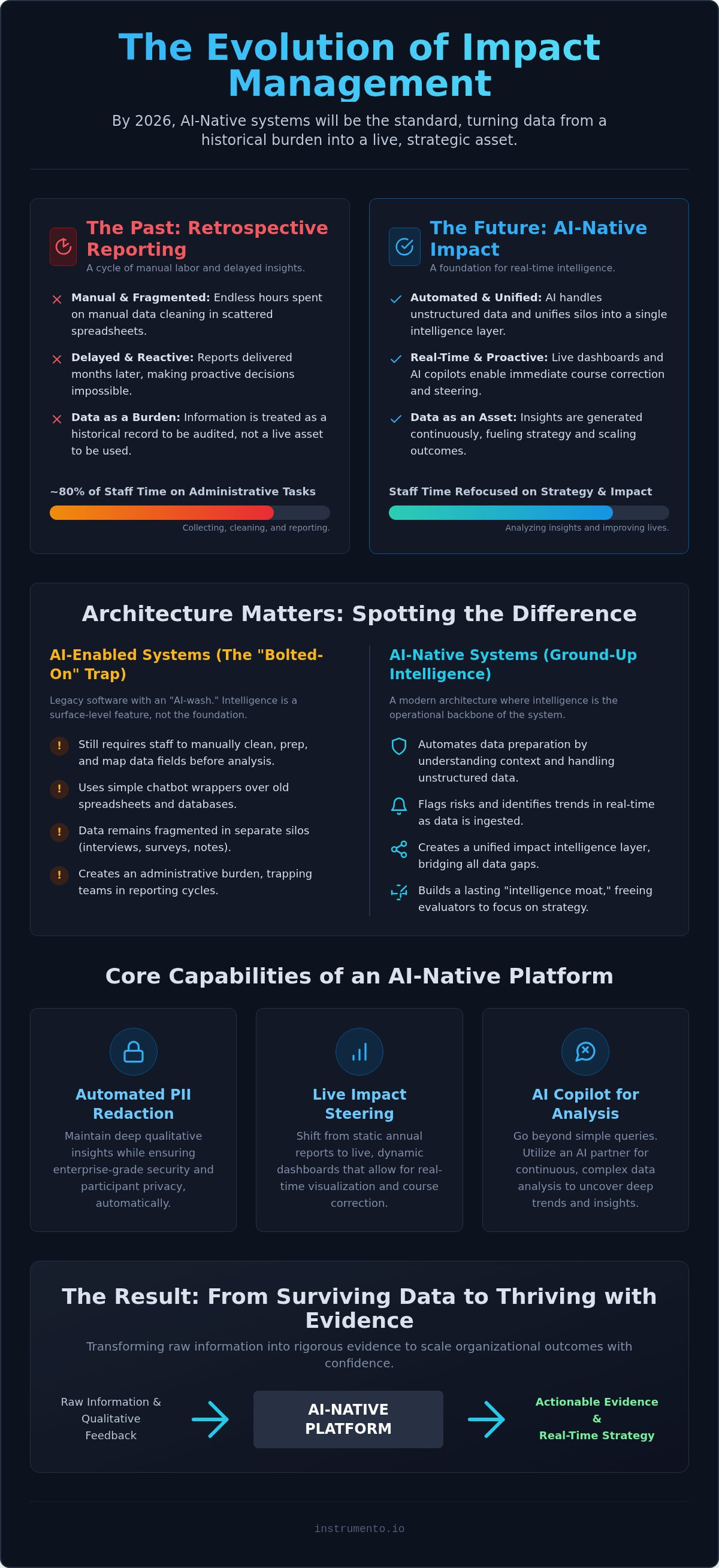
Don't fall for the "bolted-on" feature trap. Many legacy platforms attempt to "AI-wash" their software by adding a simple chatbot wrapper over old spreadsheets. An AI-enabled tool still requires you to clean data, prep files, and map fields manually. Conversely, a native platform handles unstructured data with ease. It digests interview transcripts, field notes, and qualitative feedback without requiring a human to translate them into a row and column. If you're still spending hours on data hygiene before you can run an analysis, you're using a legacy system in a modern mask. Native systems prioritize the transition from raw information to high-level evidence without the administrative friction.
The Architecture of Impact: Ground-Up Intelligence vs. Bolted-On Features
The technical gap between "AI-enabled" and "AI-native" isn't just semantics; it's a structural divide that determines if your data remains a liability or becomes an asset. Many organizations struggle because they treat intelligence as a surface-level feature. To truly understand What is AI-Native, one must look at the foundation. A ground-up architecture doesn't just add a chatbot to an old database. It rebuilds the entire stack so that every layer can communicate with, learn from, and optimize your social outcomes. AI-native impact management creates an "intelligence moat" that protects your mission from the inefficiencies of legacy software.
Traditional systems force staff to spend 80% of their time collecting, cleaning, and reporting. This administrative tax prevents organizations from scaling their actual impact. Native systems utilize LLM-orchestration to manage complex social datasets autonomously. They don't just store information; they understand it. By automating the data preparation phase, these platforms allow evaluators to focus on strategy rather than spreadsheets. It's the only viable path to achieving scalable impact analysis in a sector defined by limited resources and high expectations.
Eliminating the Data Silo Problem
Most program data lives in fragmented silos. You have qualitative interviews in one folder, quantitative surveys in another, and case notes scattered across various apps. AI-native systems act as the connective tissue that bridges these gaps. They create a unified impact intelligence layer where data flows freely between departments. By 2026, AI-native platforms ingest diverse data sources by autonomously mapping unstructured field notes, quantitative surveys, and external benchmarks into a standardized impact framework. This transition ensures that your insights are never trapped in a single spreadsheet or a forgotten document.
Building the Intelligence Moat
Organizations with native architecture iterate 10x faster than those on legacy systems. This speed is driven by the long-term value of structured, AI-ready historical data. While others are still stuck in the cycle of manual entry, native users are already generating predictive insights. This architecture reduces the administrative burden on your team, allowing them to return to the field.
- Automated Ingestion: Intelligence begins the moment data enters the system.
- Predictive Modeling: Historical data informs future program design.
- Autonomous Redaction: Privacy is maintained without slowing down the analysis.
Building a mission-driven organization requires more than just good intentions; it requires a sophisticated technology partner that understands the practical realities of program management. Native design ensures that your evidence is as rigorous as your commitment to change.
Navigating the Privacy Paradox with Automated PII Redaction
The transition to AI-native impact management often stalls due to a single, significant fear: the compromise of participant privacy. Organizations working with vulnerable populations cannot afford a data leak. You need deep, qualitative insights to understand your outcomes, yet you must keep identities safe. This tension often leads to a "privacy paradox" where data is either too vague to be useful or too risky to be stored. Automated PII Redaction resolves this conflict. It allows you to gather rich evidence while ensuring that sensitive information is never exposed to risk. By automating the protection layer, you turn security from a hurdle into a fundamental enabler of your mission.
The Mechanics of Automated Redaction
Instrumento’s redaction engine operates at the point of ingestion. It scans every document, transcript, and field note to identify names, locations, and unique identifiers. Manual redaction is notoriously slow, expensive, and prone to human error. It creates a bottleneck that prevents real-time analysis and limits the scale of your evaluation efforts. AI-driven precision, however, works in milliseconds. It doesn't just block out words; it understands context to ensure that no identifying markers remain. This process maintains strict compliance with global standards like GDPR and specific local social sector regulations. You get the depth of the narrative without the liability of the PII.
Consider the efficiency gains of this approach. Instead of a program officer spending hours scrubbing a transcript, the system handles the task instantly. This allows your team to:
- Scan incoming data for sensitive patterns automatically.
- Redact identifiers without losing the underlying narrative context.
- Secure the dataset for immediate analysis by the AI Copilot.
Trust as a Foundation for Impact
Participant trust is the most valuable asset in any impact assessment. If your beneficiaries don't feel safe, they won't share the honest truth about their experiences. Automated privacy tools empower your staff to use advanced intelligence without ethical anxiety. They no longer have to worry about accidental disclosures or the administrative burden of manual cleaning. This approach embodies "Privacy by Design," where security is built into the architecture rather than added as an afterthought. It shifts the perception of privacy from a barrier to a tool for better, more honest data. When security is automated, rigor becomes standard. By choosing AI-native impact management, you are investing in a future where data protection and program success go hand in hand.
Transforming Evaluation Workflows: From Static Reports to AI Copilots
Modern evaluation is no longer a race to meet a single yearly deadline. It's a continuous process of learning, adjustment, and optimization. By adopting AI-native impact management, organizations move from a "post-mortem" mindset to "live impact steering." This shift is powered by the AI Copilot for Data Analysis, a tool that translates complex datasets into actionable insights in seconds. It allows your team to move beyond the frustration of manual data entry and into the clarity of strategic decision-making. The goal is to turn every piece of information into a catalyst for better outcomes.
The core of this transformation lies in a streamlined, triadic workflow: Ingest, Analyze, Visualize. First, the system captures data from diverse, unstructured sources. Next, the Copilot identifies patterns, flags anomalies, and suggests causal links. Finally, Live Impact Dashboards present these findings in a format that is ready for immediate action. This structure democratizes data analysis, allowing non-technical program managers to perform high-level evaluation tasks that previously required specialized data science teams. It's about making intelligence accessible to everyone on the front lines of your mission.
Prompting for Impact: The New Evaluation Skillset
Traditional evaluation often requires deep technical knowledge of complex software or advanced statistical methods. Today, the primary skill is the ability to ask the right questions. AI Copilots act as a bridge between strategic intent and raw data, translating complex research questions into immediate queries. This allows for deep causal analysis that goes far beyond simple bar charts. For example, a program manager can use an AI Copilot to query a Theory of Change by asking, "Based on our current participant feedback, which specific intervention is most strongly correlated with improved employment outcomes for our youth cohort?" This level of specificity enables precise program adjustments that maximize participant success.
Visualizing Success via Live Impact Dashboards
The static PDF report is a relic of a slower era. It's often outdated by the time it reaches a stakeholder's inbox, making it a poor tool for agile management. Live Impact Dashboards provide a window into the present, allowing for immediate intervention when outcomes lag behind targets. This real-time transparency builds deep trust with donors and partners. You can share live results that prove your rigor, demonstrate your transparency, and validate your impact. It moves the conversation from "what happened last year" to "how we are succeeding today."
Ready to move from static reporting to real-time steering? Discover how to empower your team with the Instrumento AI-Native Impact Management Platform.
The Future of Impact: Scaling Outcomes with Instrumento
The transition to AI-native impact management is no longer a choice for organizations that want to remain relevant. It's the inevitable evolution of a sector that demands more rigor, more transparency, and more efficiency. Legacy systems have failed to keep pace with the complexity of modern social challenges. By moving toward a foundation of ground-up intelligence, you ensure that your data is always an asset, never a liability. Instrumento stands as the partner that bridges the gap between your high-level strategic intent and the granular evidence needed to prove it. It's time to move from the frustration of manual labor toward the clarity of data-driven success.
Adopting this new standard allows your leadership to stop guessing and start steering. You've seen how native architecture eliminates data silos, how automated redaction protects your participants, and how AI Copilots democratize analysis. These aren't just incremental improvements. They represent a structural shift in how social value is created and measured. Investing in an intelligence-first foundation ensures your organization is prepared for the regulatory and donor expectations of 2026 and beyond.
Why Mission-Driven Organizations Choose Instrumento
We built our platform at the intersection of technical rigor and empathetic sector understanding. We know that program managers don't have time for software that adds to their administrative workload. Our architecture respects the practical realities of fieldwork, case management, and stakeholder reporting. By choosing Instrumento, you are investing in a long-term foundation for organizational growth. You benefit from a system that evolves with your programs, learns from your historical data, and protects your participants with automated security.
- Secure your data: Deploy automated PII redaction to maintain trust.
- Empower your staff: Utilize an AI Copilot for instant, complex analysis.
- Engage your donors: Provide transparency through live impact dashboards.
Getting Started with AI-Native Management
Modernizing your impact tech stack doesn't require a total overhaul of your current workflows. The first step involves assessing your data maturity and identifying quick wins for automation. Instrumento is designed to integrate without disrupting your existing data collection processes. We help you map your Theory of Change to our dynamic models, ensuring a smooth transition to real-time steering. Stop looking backward at what happened last year and start optimizing what's happening today. Experience the future of evaluation with an Instrumento demo.
Steering the Future of Social Outcomes
The shift toward AI-native impact management represents a fundamental departure from the administrative burdens of the past. By 2026, the organizations that thrive will be those that replaced retrospective reporting with real-time outcome steering. You've seen how ground-up architecture eliminates data silos, how automated PII redaction secures participant trust, and how AI Copilots democratize complex analysis. This is the structural evolution required to move from surviving the data to thriving with the evidence.
Instrumento is your mission-driven partner in this transition. Our platform is built by sector practitioners who understand your operational realities. We provide enterprise-grade PII redaction, real-time outcome visualization, and the technical rigor needed to scale your social impact. It's time to leave behind the exhaustion of manual spreadsheets and embrace the clarity of automated success. Your mission deserves a foundation that is as ambitious as your goals. We're here to help you bridge the gap between intention and impact.
Book a demo of the Instrumento AI-Native Impact Management Platform today and begin steering your impact with precision.
Frequently Asked Questions
What is the difference between AI-native and AI-enabled software?
AI-native software is built with intelligence at its core, while AI-enabled software simply adds AI features to a legacy system. Native platforms handle data ingestion, cleaning, and analysis autonomously from the ground up. This architecture eliminates the manual prep work required by older systems. It ensures your organization moves from retrospective auditing to real-time steering with a unified intelligence layer rather than fragmented, bolted-on tools.
How does automated PII redaction protect my participants?
Automated PII redaction identifies and masks sensitive identifiers like names, specific locations, and contact details the moment data enters the system. This process ensures enterprise-grade security by removing human error from the privacy workflow. It allows you to analyze deep qualitative insights without exposing vulnerable individuals to risk. By automating this layer, you maintain strict compliance with global privacy standards while protecting the most valuable asset in your mission: participant trust.
Do I need a data scientist to use an AI Copilot for impact analysis?
No, you don't need specialized technical staff to leverage an AI Copilot for Data Analysis. The system translates natural language questions into complex data queries, allowing program managers to query their Theory of Change directly. It democratizes evaluation by handling the heavy lifting of statistical modeling and pattern recognition. This shift empowers your existing team to generate rigorous evidence and high-level insights without requiring a background in data science or advanced coding.
Can an AI-native platform handle qualitative data like interview transcripts?
Yes, handling unstructured information is a core strength of AI-native impact management. The platform ingests interview transcripts, field notes, and qualitative survey responses to identify emerging themes and causal links. Unlike traditional databases that require manual coding, the AI understands the narrative context immediately. This allows your organization to move beyond simple metrics and capture the rich, complex stories that define your social impact.
How do live impact dashboards help with donor reporting?
Live impact dashboards replace static, outdated PDF reports with real-time performance monitoring. They provide donors with a transparent window into your current progress, building deeper trust through immediate evidence of success. Instead of waiting for an annual report, stakeholders can visualize outcomes as they happen. This continuous transparency demonstrates organizational rigor and allows you to communicate your mission's value with confidence and clarity at any moment.
Is AI-native impact management secure enough for sensitive NGO data?
Security is a foundational element of the AI-native impact management architecture. Instrumento utilizes cloud-based encryption, automated PII redaction, and enterprise-grade protocols to protect sensitive NGO information. We recognize the ethical responsibility of handling beneficiary data and have built our platform to exceed standard compliance requirements. This focus on Privacy by Design ensures that your data remains secure, private, and fully under your organizational control at every stage.
Will AI replace the need for traditional program evaluation?
AI does not replace the evaluator; it amplifies their expertise. Traditional evaluation often gets bogged down in manual data cleaning and administrative overhead. AI-native tools automate these burdens, allowing practitioners to focus on high-level strategy, ethics, and program design. The technology acts as a sophisticated ally that provides the evidence needed for better decision-making. It transforms the role from a data processor into a strategic architect of social change.
How long does it take to implement an AI-native impact management platform?
Implementation is designed to be swift and non-disruptive to your current operations. Because Instrumento is a cloud-based platform, you can begin the onboarding process immediately without installing on-premise software. Most organizations identify quick wins for automation within the first few weeks of integration. We help you map your existing data sources and Theory of Change to our dynamic models, ensuring a rapid transition from manual labor to data-driven success.